
Home › Wood Fences
Wood Fence Installation in Massachusetts and New Hampshire
A stockade line across the back of the yard, a picket fence along the front walk, split rail at the edge of a field, or solid boards to keep the dog in. Wood covers a lot of looks, and the height you settle on decides which state and town rules come into play. Call (978) 800-2452 or send the form. A person reads every request and replies with what happens next.
- No charge to you
- Screened contractors only
- MA and NH rules covered
Ask About Fence Service in Your Area
Tell us the style, the height and roughly how many feet of fence. A person reads it and replies with what happens next.
Please add your name, a 10-digit phone number and a valid email.
Your request didn't go through on our end. Please call (978) 800-2452 so it isn't lost.
Too many requests have come from this connection in a short time. Please call (978) 800-2452 and we'll take it from there.
We couldn't finish the spam check. Wait a moment and send it again, or call (978) 800-2452.
Styles, posts and lumber
Planning a wood fence
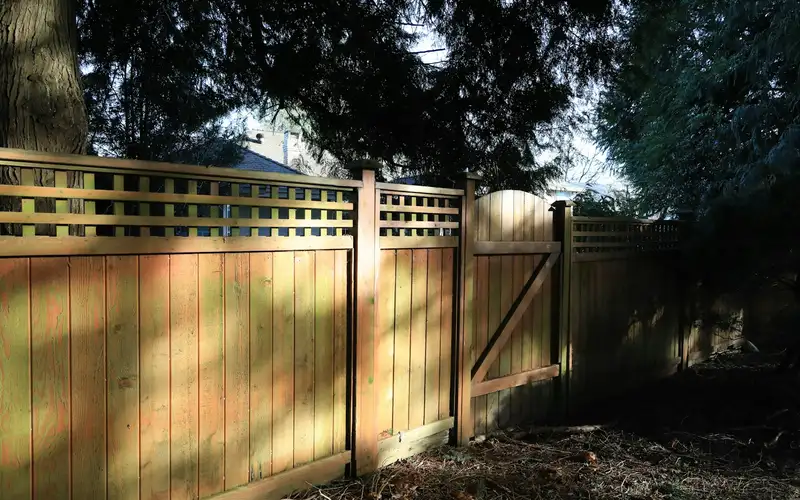
Style follows purpose. Solid styles such as stockade, board-on-board and shadowbox give the most privacy and screen a patio or a busy road. Picket and spaced-board fences mark a front yard and keep small children or pets in without closing it off. Split rail and post-and-rail outline a property line or a garden and suit open lots. A lattice top can add height and light to a privacy run.
Posts carry the fence. Much of the trouble with wood fences starts at the posts, where wood meets wet soil and winter frost works on anything set too shallow. Ask how deep the posts will go, whether they will sit in concrete or compacted gravel, how the gates will be hung and braced, and what happens if the auger hits ledge or roots.
The lumber and its upkeep. Cedar and pressure-treated pine are the common choices, and some contractors also offer other species. Wood weathers, so ask what stain or sealer the contractor recommends and how often, and keep soil, mulch and sprinkler spray off the bottom boards where you can.
Before the first hole. Be sure where the property line is, settle the height with the town, and make sure Dig Safe has been called. See also fence repair for a wood fence that is leaning or rotting.
Massachusetts
A wood fence in Massachusetts
Height and the permit. The state building code exempts "Fences not over seven feet" high from a building permit (780 CMR R105.2), while the state contractor chart says no permit or construction supervisor license is needed for a fence "under seven feet high" (HIC contractor resources). A six-foot privacy fence sits inside both, yet town zoning can still limit height along a street or at a corner and may call for a zoning or fence permit, so check with the town.
Who builds it. A contractor that works only on fences is exempt from Home Improvement Contractor registration (201 CMR 18.01); one that also builds decks or other covered work must be registered, and you can check on the Contractor Hub. The Guaranty Fund, which repays up to $25,000 of actual losses (as of November 2026), is open only to homeowners who hired a registered contractor (OCABR homeowner resources), so put a fence-only job in writing and keep the deposit modest.
Digging and neighbors. Augering post holes is excavation under state law (<a href="https://malegislature.gov/Laws/GeneralLaws/PartI/TitleXIV/Chapter82/Section40">M.G.L. c.82 §40</a>); notice to Dig Safe is due at least 72 hours ahead, not counting weekends and legal holidays (M.G.L. c.82 §40A). A fence that unnecessarily exceeds six feet and is put up maliciously to annoy a neighbor is a private nuisance (M.G.L. c.49 §21).
New Hampshire
A wood fence in New Hampshire
Ask the town. Towns and cities issue building permits and may keep codes stricter than the state's (RSA 155-A:2), so the building department tells you whether a wood fence of your height needs a permit, and zoning covers setbacks and limits near the road. The 2024 code editions took effect July 1, 2026; either set is accepted through December 31, 2026, and the 2024 codes govern permit requests from January 1, 2027 (Town of Merrimack code page).
Hiring and digging. The Attorney General says "contractors do not need to be licensed" in New Hampshire and recommends references, proof of insurance and a written contract before any work or payment (NH Attorney General). Post holes need Dig Safe notice at least 72 hours ahead, excluding weekends and legal holidays, with the area premarked in white (RSA 374:51). New Hampshire's spite fence law starts at 5 feet: a fence unnecessarily taller than that, kept up to annoy the neighbors, is a private nuisance (RSA 476:1).
New Hampshire fence rules and the towns we cover.
Last verified November 2026. Fees, restrictions and deadlines on this page are due for re-checking by January 2027. New England Fence Pros is a referral service. We don't sell or install fences.
FAQ
Wood fence questions
Does a 6-foot wood privacy fence need a permit?
In Massachusetts, the state building code lists fences not over seven feet high among work that needs no building permit, but town zoning can still cap height near streets and corners or require its own permit. In New Hampshire, the town decides. In either state, ask the building or zoning office before ordering lumber.
What kinds of wood are fences usually built from?
Cedar and pressure-treated lumber are the usual choices. Cedar heartwood resists rot naturally and weathers to gray if left unfinished; pressure-treated pine is treated against rot and insects. Ask the contractor which it installs, how it sets posts, and what upkeep it suggests.
Can a wood fence be a pool barrier?
It can if it meets the pool code your building department enforces. Federal CPSC guidance asks for at least 48 inches of height, no gap a 4-inch sphere can pass, and, when horizontal rails are less than 45 inches apart, rails on the pool side with board gaps of 1¾ inches or less. Open styles such as split rail fall far short of that on their own.
Can a tall privacy fence get me in trouble with the neighbors?
Zoning sets the height limit. The spite fence laws are narrower: Massachusetts treats a fence as a nuisance only when it unnecessarily exceeds six feet and was put up maliciously to annoy, and New Hampshire uses a 5-foot threshold with the same idea of purpose. If you are unsure where the line runs, start with a survey or the town.
Do I pay New England Fence Pros anything?
No. Sending a request and being referred are free; the fence contractor prices the job itself.
Town guides
Local rules for wood fences by town
Each town page explains when that town wants a fence permit, the height and setback limits, pool barrier and historic rules, and the kinds of homes there. Towns with a local guide so far: Greater Lowell, MA (Lowell, Chelmsford, Dracut, Tewksbury, Billerica, Westford, Tyngsborough and Pepperell), Andover, Lawrence & Haverhill, MA (Methuen, Lawrence, Andover, North Andover and Haverhill), Woburn, Reading & Melrose, MA (Woburn, Lexington, Burlington, Wilmington, North Reading, Reading, Wakefield, Melrose, Stoneham and Winchester), Nashua Region, NH (Nashua, Hudson and Merrimack), Salem, Derry & Londonderry, NH (Pelham, Salem, Windham, Derry and Londonderry), Manchester & Bedford, NH (Manchester and Bedford) and Portsmouth, Dover & Rochester, NH (Portsmouth, Dover and Rochester). We add towns across New England as we can cover them properly.